kaimb Founders ·
The Self-Awareness Gap: Why 85% of Leaders Are Developing the Wrong Skills
Summary
95% of leaders believe they're self-aware. Only 15% actually are. That gap isn't a confidence problem. It's a measurement problem.
Organizations spend $300 billion+ annually on leadership development. Only 11% of executives say it works. The reason: most programs assume leaders know their starting point. They don't.
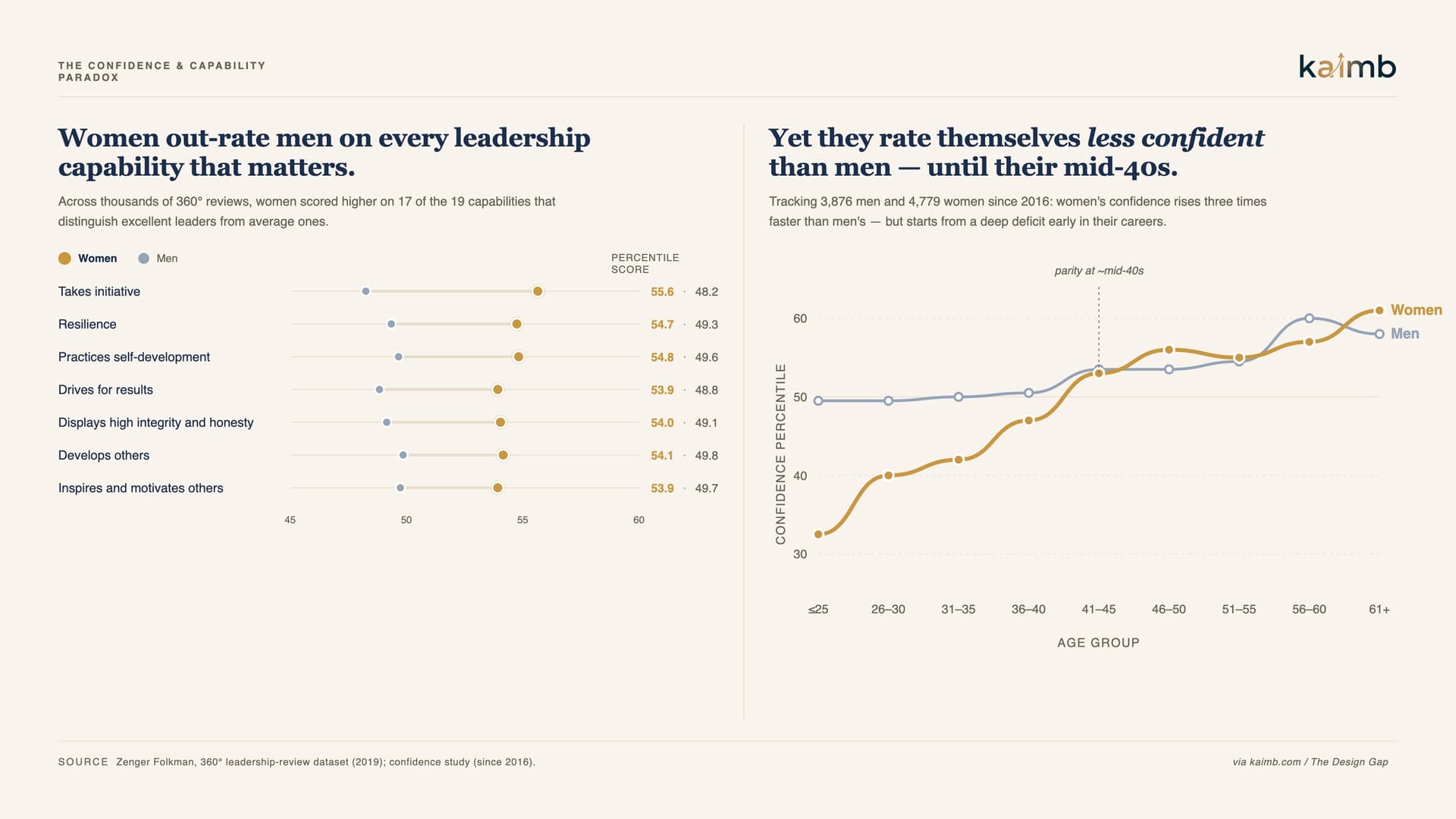
For women, the gap cuts deeper. Zenger Folkman data shows women score higher than men on 17 of 19 leadership competencies, yet rate their own confidence lower. Systems built on self-assessment systematically overlook the most capable leaders.
The gap isn't confidence. It's the instrument we use to measure it.
The Two Sides of Self-Awareness
Tasha Eurich's five-year research program revealed something uncomfortable: self-awareness has two distinct components. Internal self-awareness (how you see yourself: your values, aspirations, strengths) and external self-awareness (how others experience you). Most leadership programs only address the first.
The result: leaders who deeply understand their own values and intentions but remain oblivious to how their behavior actually lands. Internal self-awareness without external feedback creates what Eurich calls "introspectors": people who know themselves well but don't understand their impact on others.
"Un-self-aware colleagues aren't just frustrating; they can cut a team's chances of success in half." — Tasha Eurich, organizational psychologist
The $300 Billion Blind Spot
The global leadership development market is valued at $300 billion+ annually. That's a staggering investment. But the returns tell a different story.
- Only 11% of executives strongly agree their leadership development achieves desired outcomes
- Only 20% of skills taught in leadership programs transfer into new leadership habits
- 81% of organizations don't measure ROI on leadership development at all
The structural problem: these programs assume leaders know their starting point. When 85% of leaders lack accurate self-awareness, the development plan starts in the wrong place. You wouldn't build a building without surveying the foundation. Yet that's exactly what most leadership development does.
The Confidence-Competence Inversion
This is where the data gets sharp. Zenger Folkman analyzed thousands of 360-degree reviews (3,876 men and 4,779 women) and found a striking paradox: women outscored men on 17 of the 19 capabilities that differentiate excellent leaders from average ones. Yet women rated their own confidence significantly lower, especially before age 40.
"It's highly probable that those women are far more competent than they think they are, while the male leaders are overconfident and assuming they are more competent than they are." — Zenger & Folkman, HBR
The implication is significant. In any system that relies on self-nomination, self-assessment, or self-advocacy to identify talent, the more competent leaders are structurally disadvantaged. Self-perception is not self-knowledge. And when the instrument for identifying potential is built on self-perception, it amplifies the confidence gap instead of closing it.
The Introspection Trap
More self-reflection doesn't automatically produce more self-awareness. Eurich's research reveals a critical nuance: leaders who ask "why" questions tend to spiral into rumination. "Why did that go wrong?" "Why don't they respect me?" These questions feel productive but often lead to circular, unresolvable thinking.
Leaders who shift to "what" questions gain more productive insight. "What am I feeling?" "What happened in that meeting?" "What can I do differently next time?" The shift from "why" to "what" moves from judgment to observation, from rumination to action.
Self-awareness isn't a personality trait that some people have and others don't. It's a buildable skill with a specific technique. But the technique requires an instrument: structured feedback that gives leaders accurate data, not just their own reflections.
The India Gap: Infrastructure Without Insight
KPMG/AIMA's Women Leadership in Corporate India 2026 survey reveals a pattern that sharpens this argument for India Inc.
- 50% of women did not participate in any leadership development program in the past year
- Among those who did, confidence building (32%) is the #1 stated need for advancement
- Only 28% find promotion processes transparent (down from 38% in 2024)
- 24% perceive biases in promotions (up from 15%)
- Women's aspiration to leadership has dropped from 87% (2024) to 79% (2026)
The connection is clear: when confidence is the #1 stated need but no structured instrument exists to measure actual competence, "build confidence" becomes self-help, not development. Indian women leaders may not lack confidence. They may lack accurate data on their own strengths.
When aspiration to leadership drops from 87% to 79% in two years and only 28% find promotion processes transparent, the signal is clear: leaders are disengaging not from ambition but from systems they don't trust to see them accurately.
The Hidden Cost: Identity Labor
The Week (Feb 2026) describes what many women leaders experience as "identity labor": the invisible cognitive and emotional drain of constantly navigating contradictory standards. Be assertive but not intimidating. Be confident but not dominant. Be empathetic but not emotional.
This is a systems signal, not a personal shortcoming. And it connects directly to the self-awareness gap: when you spend energy wondering "Am I being perceived correctly?", structured assessment data replaces that guesswork. Instead of monitoring perceptions, you work from evidence. Here's where your leadership strengths actually are. Here's what to build next.
What a Better Instrument Looks Like
The fix isn't more introspection. It's better measurement. Structured, competency-based assessment that replaces subjective self-perception with data.
When a development plan asks "How do you see yourself as a leader?" it invites self-perception (which, for 85% of leaders, is inaccurate). When an assessment measures specific competencies against defined benchmarks, the feedback is about demonstrated capability, not self-reported confidence.
- For women: it corrects the confidence-competence inversion. You get data on what you're actually good at, not what you think you're good at.
- For managers: it replaces self-nomination (which rewards overconfidence) with structured evidence of capability
- For organizations: it ties every development dollar to a verified strength or a real gap, not to what the leader thinks she needs
At kaimb, that's what we build. Assessment that produces the same quality of data regardless of who's being assessed. So development begins from where a leader actually is, not where she thinks she is.
Does your organization measure leadership strengths before designing the development plan? Discover how kaimb can help.
Frequently Asked Questions
Does this resonate with your experience? We welcome your perspective.
Get in touch