kaimb Founders ·
The Design Gap: Why Mid-Career Indian Women Disappear Before the C-Suite
Summary
The Design Gap: Why Indian Women Disappear Before the C-Suite
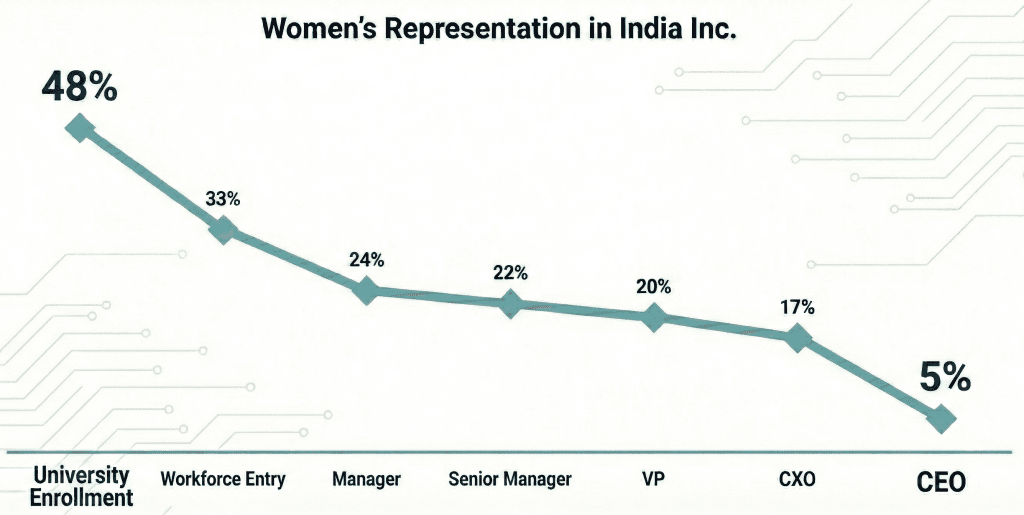
Women represent 48% of university students in India but only 5% of CEOs. The sharpest drop-offs occur in the crucial leap from mid-management to senior leadership (beyond maternity breaks).
Clear patterns emerge: “unclear promotion pathways with unwritten rules, inconsistent advancement criteria, well-intentioned assumptions that limit opportunities, cultural conditionings, and exclusion from informal networks where critical decisions are made.”
Corporate India has implemented flexible work options, mentoring circles, and diversity workshops. However, progress remains slow because these are often patchwork fixes addressing symptoms rather than root design flaws.
The Cost: Companies lose 50% profit advantage and competitive diversity benefits. India loses more than $700 billion in GDP potential.
kaimb exists to fix this design gap.
Time to Read: 5 minutes
The Problem: The Design Gap
When a bridge collapses, we examine its design—not fix the cars. The same logic applies to workplaces. Indian workplaces lose talented women not due to “lack of ambition” or “confidence,” but because our leadership pathways aren’t built for today’s realities. Career arcs in India have been shaped by legacy norms—prioritizing uninterrupted careers, informal networks, and decision-making in exclusive circles. Career breaks, caregiving responsibilities, and non-traditional journeys often come with invisible penalties.
The Leaky Pipeline
The sharpest drop-offs? Other than maternity breaks it is in the crucial leap from mid-management to senior leadership –the “broken rung” highlighted by McKinsey. Fewer than 20% of board seats and less than 5% of board chair positions go to women. Real change demands meaningful representation, yet India Inc. is still missing this vital link.
Why Does the Drop Happen?
“Literally a multi-million dollar question!” Melinda Gates committed $60 million to understand why women leave the workforce at unprecedented rates. Drawing from conversations with mid-career women and India-specific research, clear patterns emerge.
Unclear Promotion Pathways
Early career steps have clear targets: hit numbers, complete certifications, demonstrate competencies. The mid-management to CXO leap rarely receives articulation. Success hinges on relationships with decision-makers, effective self-advocacy, and navigating unwritten rules about executive presence and strategic positioning.
Same Yardsticks. Different Yardsticks. Always Same Outcome.
Career frameworks assume continuous upward trajectories, ignoring caregiving realities and flexibility needs. Yet when different standards apply, organizations make decisions for women rather than with them, assuming limitations without verification.
“My team expected me in office daily – even with a 2-hour commute and my primary manager in Singapore allowing flexibility. The India team simply wasn’t on board.” — Senior Product Leader, Payments
Research shows men are promoted based on leadership potential – what they could achieve – while women must demonstrate proven results. Male candidates were consistently ranked higher than female candidates with identical potential.
Cultural Conditioning
India’s culture and hierarchical workplaces create conditioning paradoxes. Reinforced early behaviors—not challenging authority, avoiding self-promotion, softening direct communication—work in junior roles but create double binds at senior levels requiring visible self-advocacy and decisive communication.
“My direct communication style—being straightforward rather than diplomatic—has hurt my career progression. When I asked one manager for more autonomy, he became defensive rather than supportive.” — Senior Leader, Pharma MNC
Limited Access to Informal Networks
Key opportunities and influence shape in informal settings where women remain underrepresented. During succession planning, missing critical relationships drive gaps in visibility, sponsorship, and stretch role opportunities.
Why Existing Solutions Miss the Mark?
Corporate India has rolled out flexible work options, mentoring circles, and diversity workshops. Progress is slow because these are patchwork fixes addressing isolated issues rather than root design flaws.
- Symptom-Focused Approach: Most corporate initiatives address isolated issues—flexible work policies, return-to-work programs, pay equity measures. Few tackle underlying structures: how leadership pathways are designed, succession decisions are made, or informal influence shapes careers. Global frameworks provide starting points but rarely account for India’s unique cultural dynamics.
“I’ve attended several leadership programs. They tell me to advocate for my needs, and when I do, I’m labelled aggressive. The advice isn’t wrong—it’s incomplete.” — Director, FMCG MNC
- Individual Blame Framework: Leadership programs focus on assertiveness or executive presence—suggesting problems lie with individuals, not systems. Real barriers include unclear advancement criteria and limited network access.
- Optics Over Outcomes: DEI initiatives prioritize celebratory events and panel discussions without translating into measurable improvements in promotions, retention, or career progression.
What is The Design Gap Costing India Inc.?
Fixing the design gap isn’t optional—it’s a high-ROI business priority. Replacement costs alone run 1.5 to 2 times a senior leader’s salary, but that’s the least of it. The real cost is far steeper. Every woman who exits before the C-suite represents lost revenue, innovation, and competitive advantage, for both organizations and our country. But most importantly, a lost pathway to other women!
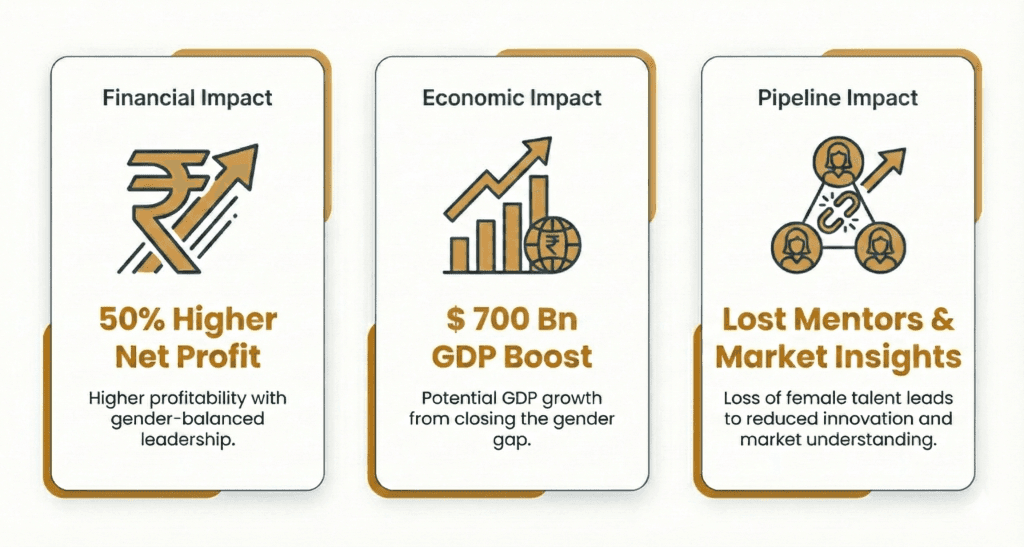
The design gap isn’t a diversity problem – it’s a business problem. Organizations that redesign their leadership pathways for today’s reality won’t just retain more talent; they’ll gain a measurable competitive advantage. The question isn’t whether to act, but how quickly you can start.
kaimb is building the missing playbook—decoding the mid-management to CXO transition for mid-career women in India through diagnostic assessments, contextual coaching, and access to critical networks. Discover how kaimb can help.
Frequently Asked Questions
Does this resonate with your experience? We welcome your perspective.
Get in touch